FAVORABLE TIME TO VISIT BHUTAN
Tours can be planned throughout the year, but the best months are March, April, May, September, October, and November. Several festivals take place during these months, offering an added attraction.
Winter in Bhutan is from mid-November to mid-March, and at this time of the year, the climate is dry and sunny for most parts with a perfect blue sky, temperatures peaking at around 15 degrees Celsius in the daytime and falling below zero at night.
The monsoon usually arrives in mid-June, with light rain falling mainly in the afternoons and evenings.
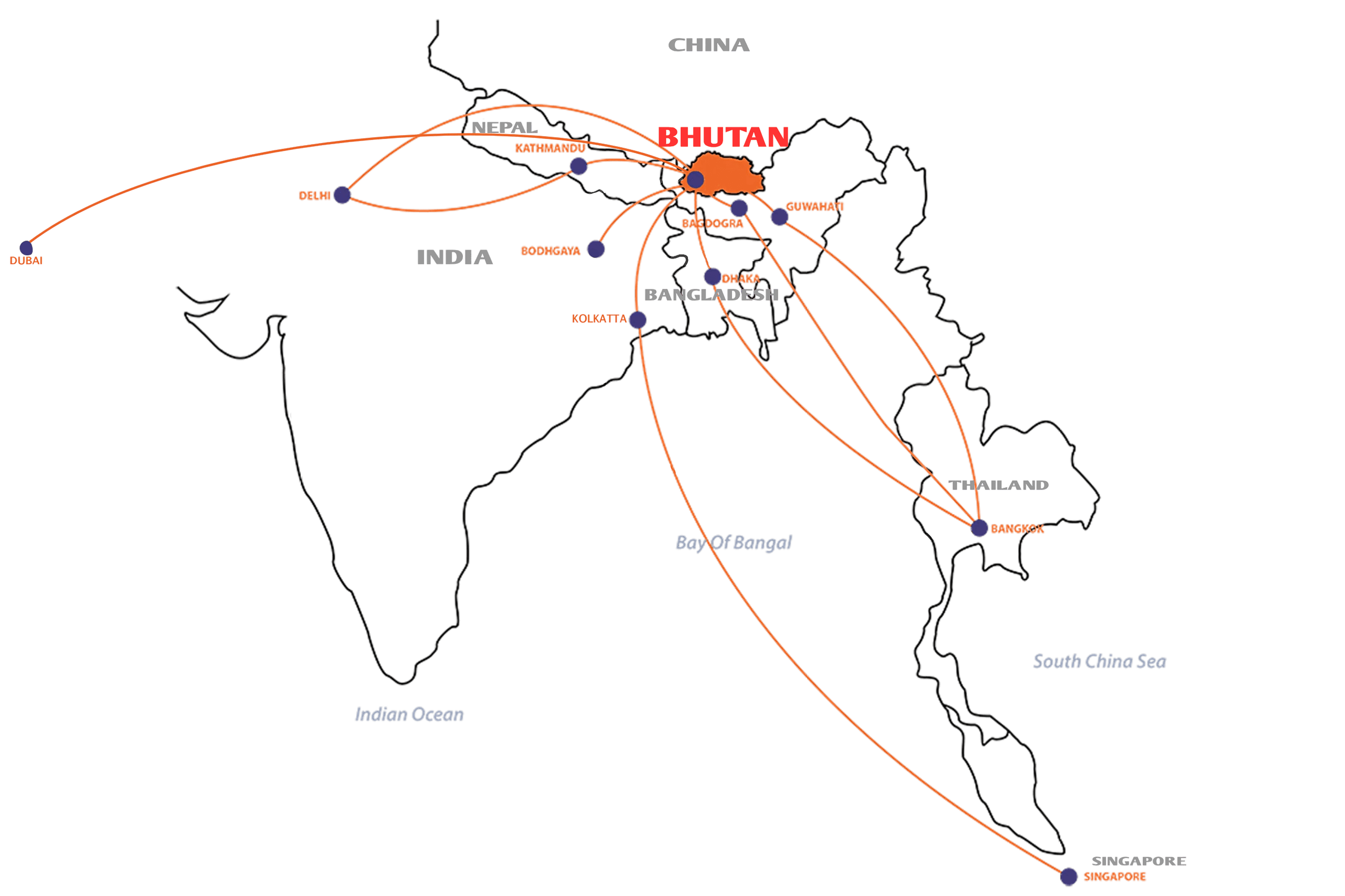
Bhutan’s only international airport is located in Paro, western Bhutan. Visitors can travel to Bhutan by taking flights from Bangladesh (Dhaka), India (Delhi, Kolkata, Guwahati, Bodh Gaya and Bagdogra), Nepal (Kathmandu), Singapore (Changi), and Thailand (Bangkok). For now, two airlines fly into Bhutan, namely Drukair and Bhutan Airlines.
All visitors can also enter via land from Phuentsholing in the south, while Indian guests can enter Bhutan via other land entry points such as Gelephu, Samdrup Jongkhar, and Samtse. There are domestic flights to Bumthang (Central Bhutan), Gelephu, Sarpang (Southern Bhutan), and Yonphula, Trashigang (Eastern Bhutan).
VISA TO BHUTAN AND ENTRY PERMIT
Tourist visas are required for all travelers and must be obtained before arriving in the country. The visa is approved in advance, and a visa clearance letter is issued.
Indian nationals visiting Bhutan do not require a visa. However, they will be issued an entry permit. ‘Entry Permit’ will be issued by the Department of Immigration at the airport on arrival and in the Pedestrian Terminal at Phuentsholing. But we recommend arranging your permit or visa beforehand.
TOURIST TARIFF AND SUSTAINABLE DEVELOPMENT FEE (SDF)
All international visitors visiting Bhutan will have to pay a Sustainable Development Fee of USD 100 per person per night. For children between 6 to 12 years of age visiting as tourists can pay USD 50 per day. These incentives are valid until 31st August 2027.
For regional tourists (India), the Sustainable Development Fee is set at BTN/INR 1200 per person per night. The Sustainable Development Fee (SDF), however, exempts day tourists (Indians) who do not travel past the first designated location (Border Town, Phuentsholing).
For Bangladeshi tourists, the SDF is set at USD 15 per person per night for the first 15,000 tourists visiting Bhutan every year.
As part of the visa application process, you will be required to pay the Sustainable Development Fee. Children aged 6-12 at the time of travel receive a 50% concessionary discount from the regular SDF. Children who have not yet turned 6 are exempted from paying any SDF.
The government of Bhutan has always adopted a cautious approach, placing the right balance between sustainability and enriching travel experiences at the heart of its “High Value, Low Volume” policy. The New SDF is set to make the country an exclusive travel destination and it’s driven by an enhanced and revitalized “High Value, Low Volume” policy which was adopted when Bhutan first welcomed tourists in 1974.
Our country has always taken pride in being a carbon-negative country and putting environmental conservation at the forefront of policy. The transformative times brought on by COVID-19 and other factors have made our tiny kingdom take a pragmatic approach to ensure the upkeep of sustainability initiatives adopted by our forefathers. It became inevitable to take these steps to avoid the looming negative impacts that mass tourism could have on a tiny country like Bhutan.